


The four-day workweek arrives in most conversations as a headline. A pilot somewhere reported happier staff and steady revenue, the story circulates for a week, and nobody in an Indian talent function does anything differently on Monday.
This session skips the headline and goes to the operational question. If a four-day workweek reached India Inc, what would a talent team actually have to do differently?
The evidence base is real but narrower than the coverage suggests. The UK pilot run by 4 Day Week Global with Autonomy and researchers at Cambridge and Boston College covered 61 companies and around 2,900 workers between June and December 2022. Burnout fell for 71% of employees, 39% reported less stress, and revenue rose 1.4% on average. A follow-up a year later found most participants had kept the shorter week in place.
Encouraging, and mostly drawn from small and mid-sized Western companies. India Inc is GCCs, services businesses, client-hour commitments, and shift-based operations. Whether the four-day workweek survives contact with that structure is an open question, and it is the one Sangeetha Sivaraj came on to answer.
Why The Indian Version Is A Different Debate
In a services economy, hours are frequently what gets billed. In a GCC, the calendar belongs partly to a parent company in a different timezone. In support and operations, coverage is the product.
None of that makes a four-day workweek impossible. It does mean the version that works here will look different from the one in the pilot reports, and the talent function will be asked to design it, staff it, and sell it to candidates long before the policy is settled.
What A Four-Day Workweek Would Change
Five questions, all of them practical.
What does it change about hiring? A four-day workweek is either a powerful differentiator in a competitive market or an operational constraint that shrinks who you can hire, and it depends entirely on the role.
Does TA get tighter or more relaxed? Fewer working days means fewer interview slots, tighter scheduling, and less slack in the process. Whether that discipline improves hiring or breaks it is genuinely arguable.
What should change in how performance gets measured? Output measurement built on presence collapses immediately under a four-day workweek. Most organisations discover their metrics were attendance metrics only when they try this.
Which functions never get one? Some teams cannot have it without a headcount increase that defeats the purpose. Saying so honestly is better than an uneven rollout that breeds resentment.
What happens to compensation and levelling? If output holds at 80% of the time, the conversation about what the other 20% was worth becomes unavoidable, and a four-day workweek forces it into the open.
What To Bring To The Session
Before Thursday, look at your last month of calendars and ask which meetings would simply not happen if there were four days to hold them in. Most teams find a surprising amount that survives only because the time exists to fill.
That is the honest starting point for a four-day workweek conversation. Not whether people would be happier with a day back, which is not in doubt, but whether the work as currently designed could absorb the loss of a day without pushing the same volume into the remaining four. Sangeetha and Sarbojit will take questions on exactly that, so bring the specific constraint your function is stuck on.
Who Should Attend
Talent acquisition and HR leaders who will be asked about a four-day workweek by a candidate, a CEO, or a board before they have a position on it. People managers running teams where coverage is the constraint. Anyone building an employer brand around flexibility who wants to know what the operational version costs.
The session builds on The Surprising State Of Work-Life Balance, where two talent leaders discussed why better policy has not reduced the pressure people report, and The Unbundled Employee Experience, on giving people real choice in how work is designed.
Event Details
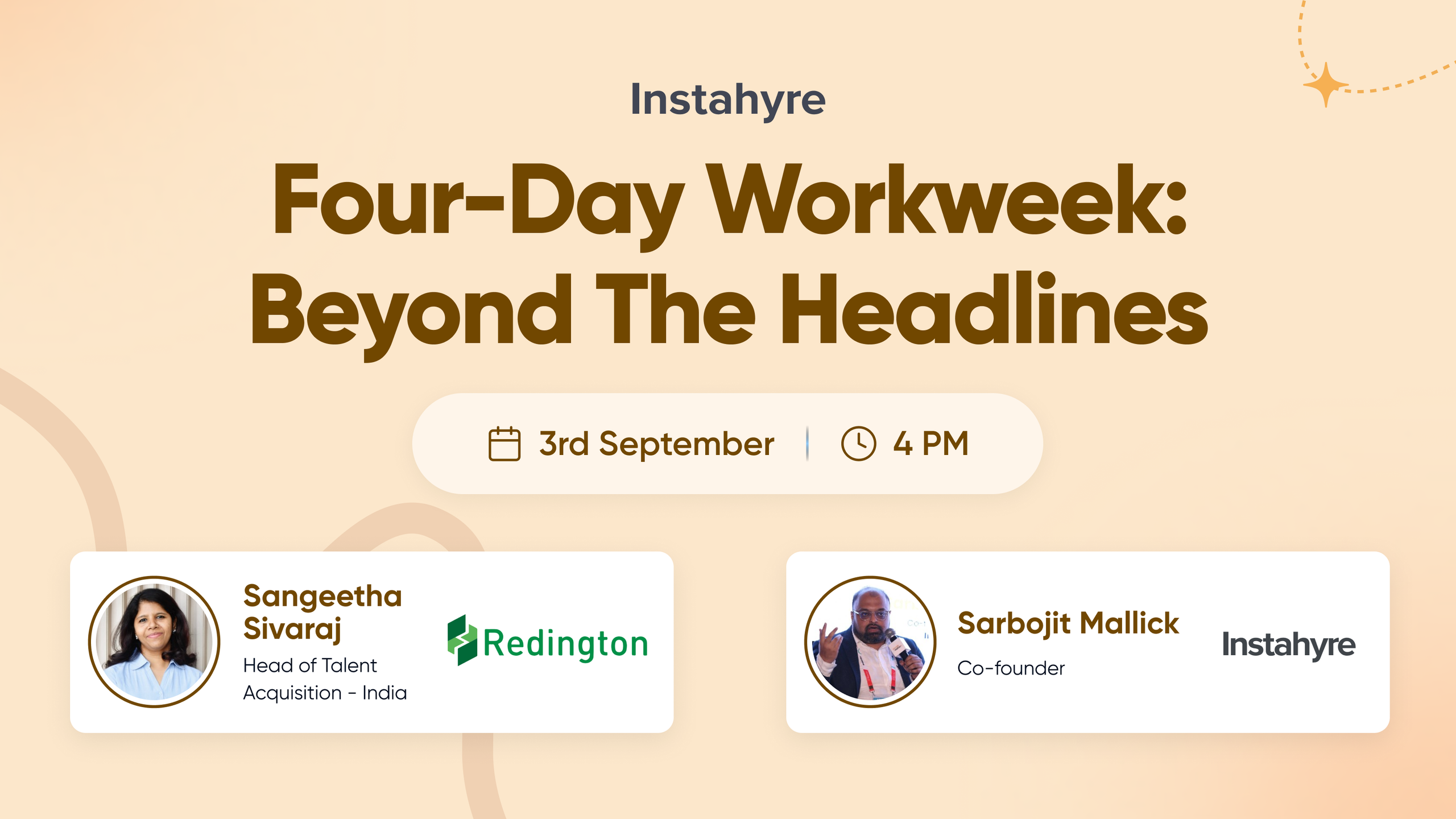
Date: Thursday, 3 September 2026 Time: 4:00 PM to 5:00 PM IST Where: LinkedIn Live and YouTube Live Speaker: Sangeetha Sivaraj, Head of Talent Acquisition, India, Redington Host: Sarbojit Mallick, Co-founder, Instahyre

More on employer branding


Ready to see Instahyre in action?
Ditch the mass emails, job ads, and manual resume screening. Source, Engage and Interview using AI
Get Started for FreeWant to be a part of Exclusive, Invite - only Recruitment events?
Get notified when new stories and insights are released.
You always have the choice to unsubscribe.
