


Table of Contents
Last updated: June 2026 · Aligned with ATS/AI screening and what Indian PM hiring managers actually evaluate.
Quick answer: A strong PM resume is built around outcomes and judgment, not features shipped. Every bullet should connect a product decision to a business metric (“launched X, driving Y% increase in Z / ₹N revenue”). Lead with impact, show the full arc (problem → decision → result), and demonstrate cross-functional leadership. Position differently based on your path: engineers emphasize technical depth + product sense; MBAs emphasize structured thinking + stakeholder leadership. One page (under 10 yrs), single-column, ATS-parseable.
PM resumes are judged differently from engineering resumes. A hiring manager scanning a PM resume is asking one question: does this person have product judgment and can they drive outcomes? Most PM resumes fail because they read like feature changelogs (“launched dark mode, launched referrals, launched checkout v2”) instead of demonstrating the judgment and impact behind those launches. This guide fixes that.
The core principle: outcomes over output
The single biggest PM resume upgrade is converting feature bullets into outcome bullets.
| Weak (output) | Strong (outcome) |
|---|---|
| “Launched a new onboarding flow” | “Redesigned onboarding based on funnel analysis; lifted activation from 41% to 58%, adding ~₹6Cr ARR” |
| “Managed the payments roadmap” | “Owned the payments roadmap; prioritized UPI autopay, which grew recurring-payment volume 3.2x in 2 quarters” |
| “Worked with engineering and design” | “Led a 9-person cross-functional pod; shipped the checkout revamp 3 weeks early, cutting cart abandonment 18%” |
| “Conducted user research” | “Ran 30 user interviews that killed a planned feature and redirected the quarter toward retention — saving ~2 months of build” |
The formula: [Product decision/action] → [why/the insight] → [quantified business outcome]. The “why” is what signals judgment — the thing PMs are actually hired for.
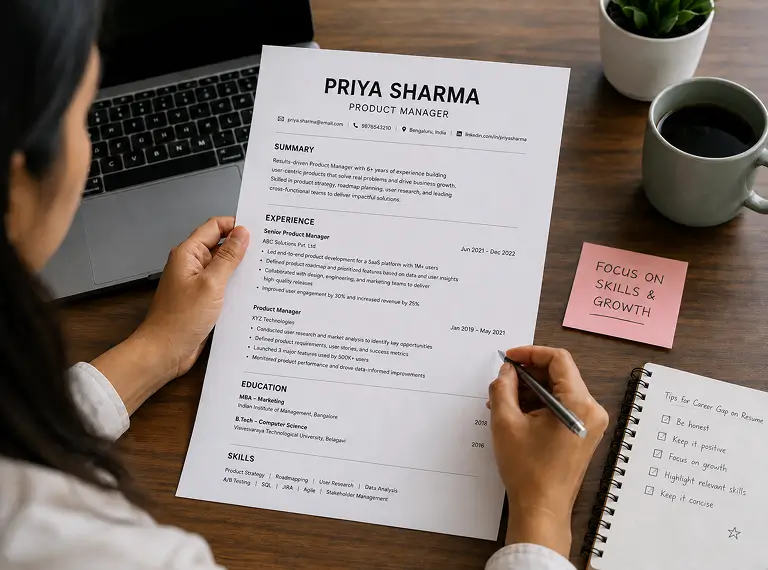
Standard PM resume structure
[FULL NAME]
[City] · [Phone] · [Email] · [LinkedIn] · [Portfolio if relevant]
SUMMARY (2–3 lines — recommended for all PMs)
[PM level] with [N] years owning [product area] at [domain].
[Core strength: 0-to-1 / growth / platform / data-driven].
[One standout outcome with a metric].
SKILLS / COMPETENCIES
Product: roadmapping, prioritization, A/B testing, user research, PRD writing
Technical: SQL, [analytics tools: Mixpanel/Amplitude], [APIs/system fluency]
Domains: [fintech / e-commerce / SaaS / AI — what’s relevant]
EXPERIENCE
[Company] — [Title] [MM/YYYY – MM/YYYY]
• [Outcome bullet: decision → insight → metric]
• [Outcome bullet]
• [Cross-functional leadership bullet]
EDUCATION
[Degree / MBA], [Institution] [Year]
[CERTIFICATIONS / SIDE PROJECTS if relevant]
Position by your path: engineer→PM vs MBA→PM vs domain→PM
PM candidates come from different backgrounds, and your resume should lean into your edge:
Engineer → PM:
- Emphasize technical depth as a differentiator (“partnered directly with eng on architecture tradeoffs”)
- Show you’ve moved beyond execution into product judgment (user impact, prioritization, metrics)
- The risk to counter: looking like a “feature manager” rather than a strategic PM. Lead with outcomes, not technical detail.
MBA → PM:
- Emphasize structured thinking, stakeholder management, and business framing
- Use internship/pre-MBA work to show product instincts
- The risk to counter: looking like a consultant who’s never shipped. Show concrete product outcomes, not just frameworks.
Domain expert → PM:
- Emphasize deep domain knowledge as your wedge (you understand the user better than anyone)
- Show you’ve translated that into product decisions with measurable results
See pay differences by path in our Product Manager Salary guide.
APM / aspiring PM resume (breaking in)
If you’re targeting an Associate PM role or transitioning in:
- Lead with any product-adjacent work: features you influenced, data analyses that changed decisions, user research you ran, side projects you built and shipped
- Quantify everything — even a side project (“built and launched a Chrome extension, 2,000 active users”)
- Show product thinking in a portfolio or case study (many PM applications expect one)
- SQL + analytics literacy is increasingly table-stakes — list it if you have it
What hiring managers scan for in 8 seconds
- Metrics. Numbers signal you measure impact. A PM resume with no numbers reads as junior regardless of title.
- Scope. What did you own? “Owned the X surface” beats “contributed to X.”
- The arc. Problem → decision → result. This is judgment, the core PM skill.
- Cross-functional leadership. PMs lead without authority; show it.
- Relevant domain. Fintech PMs hiring want fintech context; tailor it.
What to cut from a PM resume
- Feature changelogs with no outcomes
- Buzzword soup (“synergy, ideation, growth-hacking, disruptive”)
- Vague ownership (“was involved in”, “helped with”)
- Long frameworks lists with no application (“expert in RICE, JTBD, AARRR”) — show you used them, don’t just name them
- Objective statements, photos, marital status, rating bars
Frequently asked questions
What should a product manager resume include? A 2–3 line summary, a competencies section (product + technical + domain), experience with outcome-driven bullets, education, and a portfolio link if you have one. Built around metrics and judgment, not features shipped. One page under 10 years.
How do I write PM resume bullets? Use: product decision/action → the insight behind it → quantified business outcome. The “why” signals judgment, which is what PMs are hired for. Always attach a metric (conversion, revenue, retention, engagement).
How do I write a PM resume as an engineer transitioning to product? Emphasize technical depth as a differentiator, but lead with product outcomes and judgment, not technical detail. Counter the “feature manager” risk by showing prioritization, user impact, and metrics — not just what you built.
Do I need a portfolio for a PM resume? Increasingly yes for breaking in (APM/transition). A short case study showing your product thinking (problem → research → decision → result) strengthens applications, especially when your work history doesn’t yet show PM scope.
How important are metrics on a PM resume? Critical. A PM resume without numbers reads as junior regardless of title. Every meaningful bullet should connect to a business metric — conversion, revenue, retention, engagement, time-to-market.
Should I list product frameworks (RICE, JTBD) on my resume? Only by showing you applied them (“prioritized the roadmap using RICE, focusing the quarter on the 3 highest-impact bets”). Listing framework names without application is a weak signal.
How long should a PM resume be? One page for under 10 years; two pages maximum for senior/director roles. Hiring managers skim fast — high-signal and concise wins.
Where to go from here
Rebuild your PM resume around outcomes and judgment, position it for your background, and tailor per JD.
Then:
Browse 600+ active PM, APM, and Senior PM roles on Instahyre → — recruiters reach out to you directly.
Aligned with 2026 ATS/AI screening behavior. Tailor every resume to the specific job description.

Aradhye Ackshatt
Content Strategist
Aradhye has been extracting actionable insights from salary data for recruiters in the Indian tech industry for over half a decade, before AI made the job easier! Hence, he has expanded into recruiter enablement via behavior modification workshops. Backed by Instahyre data, he publishes industry-specific salary reports every FY quarter.

More on talent intelligence




Ready to see Instahyre in action?
Ditch the mass emails, job ads, and manual resume screening. Source, Engage and Interview using AI
Get Started for FreeWant to be a part of Exclusive, Invite - only Recruitment events?
Get notified when new stories and insights are released.
You always have the choice to unsubscribe.
