


Table of Contents
Last updated: June 2026 · Practical guidance for tech roles in India.
Quick answer: Most Indian tech roles do not require a cover letter — for product companies, unicorns, and applications via referral or job portals, a strong resume is usually enough, and a generic cover letter adds nothing. Write one when: it’s explicitly required, you’re making a career switch or have an unusual story to explain, it’s a smaller/non-tech-first company, or you’re doing targeted cold outreach. When you do write one, keep it short (under 200 words / 3 short paragraphs), specific to the role, and focused on why you + why them — never a reworded resume. Template below.
The cover letter question creates a lot of wasted anxiety. The honest answer for Indian tech: it’s usually optional, occasionally valuable, and almost never the bloated 5-paragraph formal letter people imagine. This guide tells you exactly when to write one and gives you a tight, modern template when you do.
Do you even need a cover letter? (the honest verdict)
| Situation | Cover letter? |
|---|---|
| Product company / unicorn / FAANG, standard application | Usually no — resume does the work |
| Application via referral | Usually no — the referral is the intro |
| Job portal (Naukri, Instahyre, LinkedIn Easy Apply) | Usually no |
| Application form has a required cover letter field | Yes — write a tailored one |
| Career switch or unusual background to explain | Yes — it’s your chance to connect the dots |
| Cold outreach to a hiring manager / smaller company | Yes — this is where it adds the most value |
| Non-tech-first company / traditional enterprise | Often yes — they expect one |
The principle: a cover letter helps most when your resume alone doesn’t tell the full story, or when you’re reaching out directly and need to open a conversation. For a clean resume going into an Indian unicorn product company’s hiring ATS, it rarely moves the needle.
What a cover letter is actually for
A good cover letter answers two questions a resume can’t fully address:
- Why you + this specific role — the connection between your experience and what they need
- Why them specifically — that you’ve done homework and aren’t spraying applications
It is not a place to restate your resume in paragraph form. If your cover letter just narrates your work history, skip it — it adds nothing. FAANG companies rarely need cover letters.
The modern cover letter template (under 200 words)
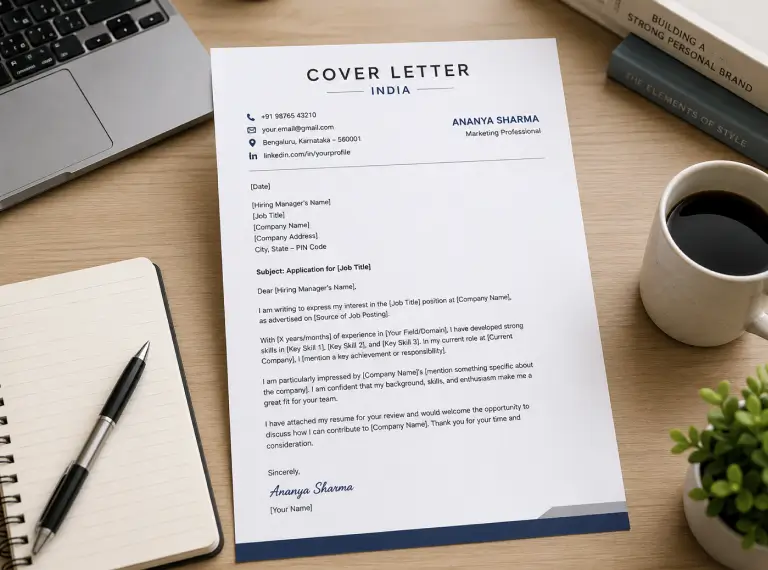
Forget the formal 5-paragraph relic. Modern tech cover letters are short, specific, and conversational:
Hi [Hiring Manager’s name, if known — otherwise “Hiring Team”],
[Opening — 1–2 sentences: who you are + why this specific role caught you.
Be specific about the company/team, not generic.]
[Middle — 2–3 sentences: your most relevant experience tied to what they
need, with one quantified achievement. The “why you” proof.]
[Why them — 1–2 sentences: a specific reason you want THIS company/team,
showing you did homework.]
[Close — 1 sentence: a confident, low-pressure sign-off.]
Best,
[Your name] · [phone] · [LinkedIn]
A filled example
Hi Priya,
I’m a backend engineer with 5 years building payment systems, and I’ve been following Razorpay’s move into recurring payments — it’s exactly the problem space I want to go deeper in.
At my current role I re-architected a refunds pipeline into event-driven services, cutting processing time from 6 hours to under 2 minutes for 2M+ monthly transactions. The role you’ve posted maps closely to that work — distributed systems, payments scale, reliability.
I’m drawn to Razorpay specifically because of your engineering blog’s depth on idempotency and reconciliation; it’s rare to see a company write so openly about the hard parts. I’d love to bring that same rigor to your team.
Happy to share more whenever useful.
Best, Arjun Mehta · +91-XXXXX · linkedin.com/in/arjun
Notice: specific company detail (recurring payments, their blog), one quantified achievement, a genuine “why them,” and brevity. That’s the whole formula.
Cover letter for a career switch
This is the scenario where a cover letter earns its keep most. Use it to connect the dots your resume can’t:
…I’m transitioning from 4 years in data analysis into ML engineering. Over the past year I’ve shipped two production ML projects [linked] applying [skills], and I’m now looking to do this full-time. My analytics background means I think about model impact in business terms from day one…
The cover letter turns “why is this analyst applying for an ML role?” from a question mark into a clear, confident narrative. Use your notice period to fine tune it for every application.
Cover letter mistakes to avoid
- Restating your resume in prose — adds nothing; skip the letter if that’s all it is
- Generic openings (“I am writing to apply for the position of…”) — boring; lead with something specific
- No company-specific detail — if you could send it to 50 companies unchanged, it’s not working
- Too long — over ~250 words and it won’t be read fully. Aim for under 200.
- Formal relic tone (“I hereby wish to express my keen interest…”) — write like a human
- Typos / wrong company name — the fastest way to get rejected; proofread, especially the company name
Where to put it
- If there’s a dedicated upload field, upload it as a PDF
- If you’re applying by email, the cover letter is the email body (don’t attach it separately) with your resume attached
- For cold outreach, it’s a short LinkedIn message or email — even tighter than the template above
Frequently asked questions
Do I need a cover letter for tech jobs in India? Usually not — for product companies, unicorns, referral applications, and job portals, a strong resume is enough. Write one when it’s explicitly required, when you’re making a career switch, for cold outreach, or for traditional/non-tech-first companies.
How long should a cover letter be? Under 200 words — three short paragraphs. Modern tech cover letters are brief and specific, not the formal 5-paragraph relic. Anything over ~250 words risks not being read.
What should a cover letter include? Why you + this specific role (with one quantified achievement), and why this specific company (showing you did homework). It should not restate your resume in paragraph form.
Should I write a cover letter if it’s optional? Usually skip it for standard product-company applications — it rarely moves the needle and a weak one can hurt. Write one if you have a career switch or unusual story to explain, or for cold outreach where it opens the conversation.
Can I reuse the same cover letter for every job? No — a generic, reusable cover letter is worse than none. The entire value is in the role- and company-specific details. If you can send it unchanged to 50 companies, it’s not doing its job.
Should the cover letter go in the email body or as an attachment? When applying by email, put it in the email body (with your resume attached). When there’s a dedicated upload field, upload it as a PDF. For cold outreach, make it an even shorter message.
Do cover letters help with the ATS? Some ATS parse cover letters; most weight the resume far more. Don’t rely on a cover letter for keyword matching — that’s the resume’s job. The cover letter is for the human, not the machine.
Where to go from here
Browse premium tech roles on Instahyre → — invite-only; recruiters reach out to you directly, so often no cover letter is needed at all.
Practical guidance for Indian tech roles in 2026; individual company requirements vary.

More on talent intelligence




Ready to see Instahyre in action?
Ditch the mass emails, job ads, and manual resume screening. Source, Engage and Interview using AI
Get Started for FreeWant to be a part of Exclusive, Invite - only Recruitment events?
Get notified when new stories and insights are released.
You always have the choice to unsubscribe.
