


Table of Contents
Last updated: July 2026 · Built from current DevOps/SRE hiring patterns in India.
Quick answer: DevOps is a mindset plus a toolchain, usually entered from a development or operations role rather than as a fresher. The path: Linux + scripting → one cloud (AWS/Azure/GCP) → CI/CD → infrastructure-as-code (Terraform) → containers & Kubernetes → observability. Certifications (AWS, CKA) meaningfully boost DevOps offers — it’s one of the few areas where certs reliably move pay. Realistic timeline: 6–12 months from a dev/ops base, longer from scratch. The senior branch leads to SRE and Platform Engineering (the highest-paid lanes).
DevOps is one of the best-paid, most in-demand tech tracks in India (see DevOps Engineer Salary) — and one of the few where certifications genuinely move your salary. But it’s widely misunderstood as a junior role you apply to directly. In reality, DevOps engineers almost always come from a development or operations background and grow into it. This guide is the honest roadmap.
What DevOps actually is
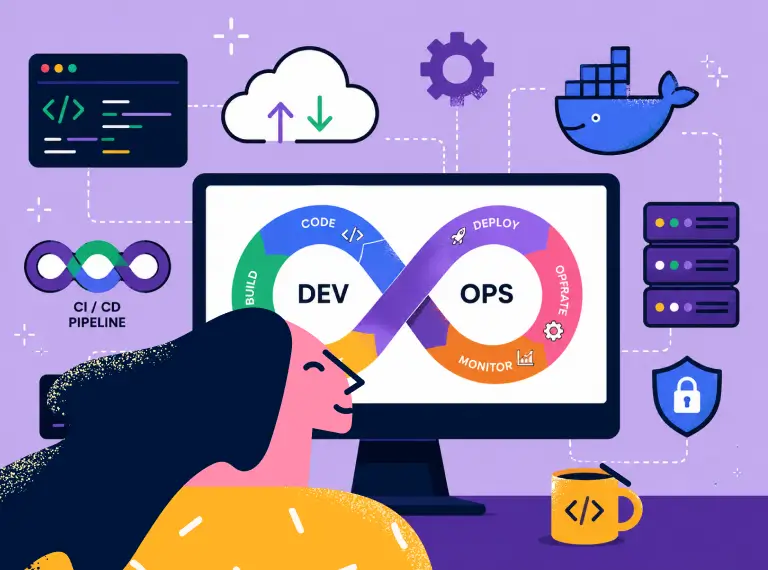
DevOps isn’t a single tool — it’s the practice of shipping software reliably and fast by automating the path from code to production. A DevOps engineer owns CI/CD pipelines, infrastructure automation, deployment, monitoring, and reliability. The related senior tracks:
- SRE (Site Reliability Engineering) — reliability, observability, on-call, error budgets (often one tier up in pay)
- Platform Engineering — building internal developer platforms
See how these compare in pay in the DevOps Engineer Salary guide.
Why it’s usually not a fresher role
DevOps requires understanding how software is built and run — so it’s hard to do well with zero experience in either. Most DevOps engineers enter from:
- Software development (you know how apps are built; you learn to deploy/operate them)
- System administration / IT operations (you know infrastructure; you learn automation and code)
- Cloud/support roles (you know the platform; you learn the DevOps toolchain)
If you’re a complete beginner, the fastest route is often to first get a foothold in development or cloud/ops, then move into DevOps.
The step-by-step roadmap
Step 1 — Linux + scripting (1–2 months)
- Comfortable on the Linux command line (the substrate of everything)
- Bash scripting and Python for automation
- Networking basics (DNS, HTTP, load balancing, firewalls)
Step 2 — One cloud platform (2–3 months)
- Pick AWS (largest market), Azure, or GCP and learn it at depth
- Compute, storage, networking, IAM, managed databases
- Get the Associate-level certification — DevOps is one of the few areas where certs reliably boost offers (see the cert ROI section in the Cloud Engineer Salary guide)
Step 3 — CI/CD (1–2 months)
- Build pipelines with GitHub Actions, GitLab CI, or Jenkins
- Automate build → test → deploy
- This is the heart of “DevOps” — automating the path to production
Step 4 — Infrastructure as Code (1–2 months)
- Terraform (the industry standard) — provision infrastructure as version-controlled code
- Configuration management basics (Ansible)
- The HashiCorp Terraform Associate cert is high-ROI-for-effort
Step 5 — Containers & Kubernetes (2–3 months)
- Docker — containerize applications
- Kubernetes — orchestrate containers at scale (the senior-defining skill)
- The CKA (Certified Kubernetes Administrator) is one of the highest-value DevOps certs
Step 6 — Observability & reliability (1–2 months)
- Monitoring and metrics (Prometheus, Grafana)
- Logging and tracing
- Alerting, incident response, SLOs — the bridge toward SRE
Step 7 — Build a portfolio + apply
- Build a real CI/CD + IaC + K8s project end-to-end and put it on GitHub
- Document it well — DevOps portfolios are about demonstrated automation
- Apply via referrals; target product companies, GCCs, and cloud-heavy startups
Certifications: the high-ROI ones
Unlike most tech roles, DevOps certs genuinely move pay. The highest-value (detailed in the Cloud Engineer Salary guide):
- AWS Solutions Architect Associate → Professional
- AWS Certified DevOps Engineer – Professional
- CKA (Certified Kubernetes Administrator)
- HashiCorp Terraform Associate (best ROI for effort)
Realistic timeline
| Starting point | Time to DevOps-ready |
|---|---|
| Working software developer | 6–10 months |
| System admin / IT ops | 6–12 months |
| Cloud support / associate | 6–10 months |
| Complete beginner | 14–20 months (often via a dev/ops foothold first) |
Common mistakes
- Learning tools in isolation — DevOps is about connecting them into a pipeline. Build an end-to-end project.
- Skipping Linux/scripting fundamentals — everything sits on top of these.
- Tool-chasing — you don’t need every tool; depth in the core chain (cloud + CI/CD + Terraform + K8s) matters more.
- Ignoring certifications — this is one role where they reliably boost offers.
- Trying to start as a fresher with no dev/ops base — get a foothold first.
- No portfolio — build and document a real automation project.
Frequently asked questions
How do I become a DevOps engineer in India? Learn Linux + scripting → one cloud platform → CI/CD → Terraform (IaC) → Docker & Kubernetes → observability, build an end-to-end automation project, and get key certs (AWS, CKA). Most DevOps engineers enter from a development or operations background.
Can a fresher become a DevOps engineer? It’s uncommon directly, because DevOps requires understanding how software is both built and run. The fastest route for beginners is usually to get a foothold in development or cloud/ops first, then move into DevOps within 1–2 years.
How long does it take to become a DevOps engineer? 6–12 months from a development or operations base; 14–20 months from scratch (often via a dev/ops foothold first). Building an end-to-end CI/CD + IaC + Kubernetes project is what makes you hireable.
Do certifications help for DevOps roles? Yes — more than almost any other tech role. AWS Solutions Architect (Associate→Professional), AWS DevOps Engineer Professional, CKA, and Terraform Associate reliably boost DevOps offers in India.
What skills does a DevOps engineer need? Linux, scripting (Bash/Python), one cloud platform at depth, CI/CD pipelines, infrastructure-as-code (Terraform), containers and Kubernetes, and observability (Prometheus/Grafana). Plus the automation mindset that ties them together.
What’s the difference between DevOps and SRE? DevOps focuses on automating the path from code to production (CI/CD, IaC, deployment). SRE focuses on production reliability (observability, on-call, error budgets) and often sits one tier higher in pay. They overlap heavily.
Is DevOps a good career in India in 2026? Yes — it’s among the best-paid, most in-demand tech tracks, with strong senior progression into SRE and Platform Engineering. It’s also one of the few roles where certifications reliably increase compensation.
Where to go from here
Build the toolchain in order, ship an end-to-end automation project, earn the high-ROI certs, and apply via referrals. Then:
- Related: How to Get A Bangalore Job · Why Become a Software Engineer
- Benchmark: DevOps Engineer Salary · Cloud Engineer Salary (with full cert ROI tables)
Browse DevOps, SRE, and Platform Engineering roles on Instahyre → — recruiters reach out to you directly.
Reflects 2026 hiring reality. The roadmap is directional — a working end-to-end project matters more than any fixed timeline.

More on talent intelligence




Ready to see Instahyre in action?
Ditch the mass emails, job ads, and manual resume screening. Source, Engage and Interview using AI
Get Started for FreeWant to be a part of Exclusive, Invite - only Recruitment events?
Get notified when new stories and insights are released.
You always have the choice to unsubscribe.
