


Table of Contents
Last updated: July 2026 · Built from current DS/ML hiring patterns in India.
Quick answer: Become a data scientist in India by building Python + SQL + statistics + ML fundamentals + 3–4 deployed, business-framed projects — and increasingly, GenAI literacy. The field has stratified: most people enter as a Data Analyst (₹4–10 LPA) and grow into Data Scientist / ML Engineer roles. A degree helps for research-heavy roles but isn’t mandatory; deployed projects with business impact beat Kaggle-only or certificate-only profiles. Realistic timeline: 10–18 months of focused effort, often via a Data Analyst entry point.
Data science remains one of the most-searched career goals in India — and one of the most misunderstood. The 2026 reality: it’s not one role but a spectrum (Analyst → Scientist → ML Engineer), the entry point for most people is a Data Analyst role, and what gets you hired is deployed work with business framing, not Kaggle medals or certificate stacks alone. This guide is the honest, current roadmap.
Understand the spectrum first
“Data scientist” is an umbrella. Knowing where you’re aiming changes your roadmap (and your pay — see Data Scientist Salary and AI/ML Engineer Salary):
| Role | What they do | Entry difficulty |
|---|---|---|
| Data Analyst | SQL, dashboards, business insights, basic stats | Lowest — most common entry point |
| Data Scientist | Modeling, statistics, experimentation + some deployment | Medium |
| ML Engineer | Production ML, MLOps, model serving, software depth | Higher (needs strong SWE) |
| GenAI/LLM Engineer | LLM apps, RAG, fine-tuning, evaluation | Higher; hottest 2026 demand |
Most realistic path for beginners: start as a Data Analyst, then grow into Data Scientist or ML Engineer over 1–3 years. Trying to start directly as an “ML Engineer” with no experience is much harder.
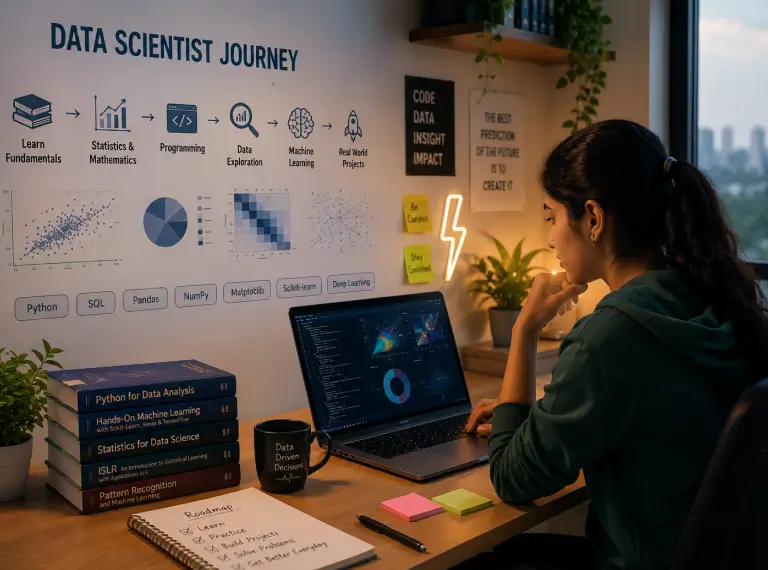
The step-by-step roadmap
Step 1 — Python + SQL (1–3 months)
- Python for data: pandas, NumPy, matplotlib/seaborn
- SQL — non-negotiable; nearly every DS/analyst interview tests it. Joins, window functions, aggregations.
Step 2 — Statistics & math fundamentals (2–3 months, overlapping)
- Descriptive + inferential statistics, probability, distributions
- Hypothesis testing, A/B testing (heavily used in industry)
- Linear algebra and calculus basics (enough to understand models, more for ML-engineer track)
Step 3 — Machine learning fundamentals (2–4 months)
- scikit-learn: regression, classification, clustering, evaluation metrics
- Feature engineering (often more impactful than model choice)
- Then deep learning basics (PyTorch) if targeting ML/AI roles
- Understand what’s happening underneath — don’t just call .fit(). Interviewers probe this.
Step 4 — GenAI literacy (1–2 months, increasingly essential)
In 2026, basic GenAI fluency is becoming table-stakes:
- LLM basics, prompt engineering, RAG (retrieval-augmented generation), vector databases
- Build one GenAI project (e.g., a RAG assistant over a document set)
- This is the single highest-demand, highest-differentiation skill area right now
Step 5 — Build 3–4 deployed, business-framed projects (3–5 months, overlapping)
This is what gets you hired. For each project:
- Frame it around a business problem, not just accuracy (“predict churn to target retention”)
- Deploy it — a model in a notebook is incomplete; wrap it in an API, link a demo
- Quantify the outcome — even on a dataset (“0.88 AUC, would save X if deployed”)
- One should ideally be a GenAI project (high signal in 2026)
See the Data Scientist Resume Template and How to List Projects on a Tech Resume for how to present these.
Step 6 — Prepare and apply (2–3 months, overlapping)
- DS interviews test SQL, stats, ML concepts, case/business sense, and often DSA (especially for ML-engineer roles — see the DSA Roadmap)
- Build a DS resume positioned for the specific role tier
- Apply via referrals; consider Data Analyst roles as an entry point
Do you need a degree or a master’s?
- Industry DS/Analyst roles: no specific degree required. Deployed projects + skills get people hired from many backgrounds.
- Research-heavy / Applied Scientist roles: a master’s or PhD is often expected (these are the highest-paying, most competitive roles).
- A master’s helps but isn’t mandatory for most industry DS work. Projects and demonstrable ability matter more for the typical path.
Realistic timeline
| Starting point | Time to job-ready (entry DS/Analyst) |
|---|---|
| CS/engineering background, some Python | 8–12 months |
| Non-CS, comfortable with math | 12–16 months |
| Complete beginner | 16–24 months |
| Working SWE moving into ML | 6–12 months (the SWE base accelerates it) |
As with all tech roles, project depth — not course count — is the real variable.
The 2026 hiring reality
- Companies value projects over degrees and certificates — a portfolio of deployed, business-framed work is the strongest signal
- Entry-level is competitive, so the Data Analyst entry point + growing into DS is the pragmatic path for many
- GenAI skills are the biggest differentiator — demand far exceeds supply
- Internships convert — a strong way into the field
Common mistakes
- Notebook-only projects — train a model, never deploy it. Deploy it.
- Chasing Kaggle medals exclusively — useful, but industry wants business framing and deployment too.
- Certificate collecting — 15 Coursera certs ≠ ability. Build instead.
- Skipping SQL — it’s tested in nearly every interview.
- Ignoring GenAI — it’s the highest-demand skill area in 2026.
- Aiming for “ML Engineer” with zero experience — start as Analyst/DS and grow in.
Frequently asked questions
How long does it take to become a data scientist in India? Typically 10–18 months of focused effort, often via a Data Analyst entry point. Working software engineers moving into ML can do it in 6–12 months because of their existing base. Project depth matters more than course count.
Can I become a data scientist without a degree in India? For industry DS and analyst roles, yes — deployed, business-framed projects and demonstrable skills get people hired from many backgrounds. Research-heavy Applied Scientist roles often expect a master’s or PhD.
Do I need a master’s to become a data scientist? Not for most industry roles — projects and ability matter more. A master’s helps and is often expected for research-heavy or Applied Scientist positions, which are the most competitive and highest-paying.
What’s the difference between a data analyst, data scientist, and ML engineer? Analysts focus on SQL, dashboards, and business insights (most common entry point). Data scientists add modeling, statistics, and experimentation. ML engineers focus on production ML and need strong software engineering. They pay differently — see the salary guides.
Is data science still a good career in India in 2026? Yes, especially the ML Engineer and GenAI sides, where demand far exceeds supply. Entry-level is competitive, so the realistic path is often Data Analyst → Data Scientist/ML Engineer. GenAI skills are the biggest differentiator.
What skills do I need to become a data scientist? Python, SQL, statistics, ML fundamentals (scikit-learn, then PyTorch for ML roles), and increasingly GenAI literacy (RAG, LLMs, vector DBs). Plus 3–4 deployed, business-framed projects.
Should I learn GenAI to become a data scientist in 2026? Yes — basic GenAI fluency (prompt engineering, RAG, vector databases) is becoming table-stakes and is the single biggest differentiator in the current market. Build at least one GenAI project.
Where to go from here
Build Python + SQL + stats + ML + GenAI literacy, ship 3–4 deployed business-framed projects, and enter via the role tier that matches your level. Then:
- Related paths: How to Become a Data Scientist · How to Become a Software Engineer
- Apply: Data Scientist Resume Template · How to List Projects on a Tech Resume
- Prep: DSA Roadmap (for ML-engineer roles)
- Benchmark: Data Scientist Salary · AI/ML Engineer Salary
Browse Data Science, ML, and Analyst roles on Instahyre → — recruiters reach out to you directly.
Reflects 2026 hiring reality. The roadmap is directional — project depth and business framing matter more than any fixed timeline.

More on talent intelligence




Ready to see Instahyre in action?
Ditch the mass emails, job ads, and manual resume screening. Source, Engage and Interview using AI
Get Started for FreeWant to be a part of Exclusive, Invite - only Recruitment events?
Get notified when new stories and insights are released.
You always have the choice to unsubscribe.
