


Table of Contents
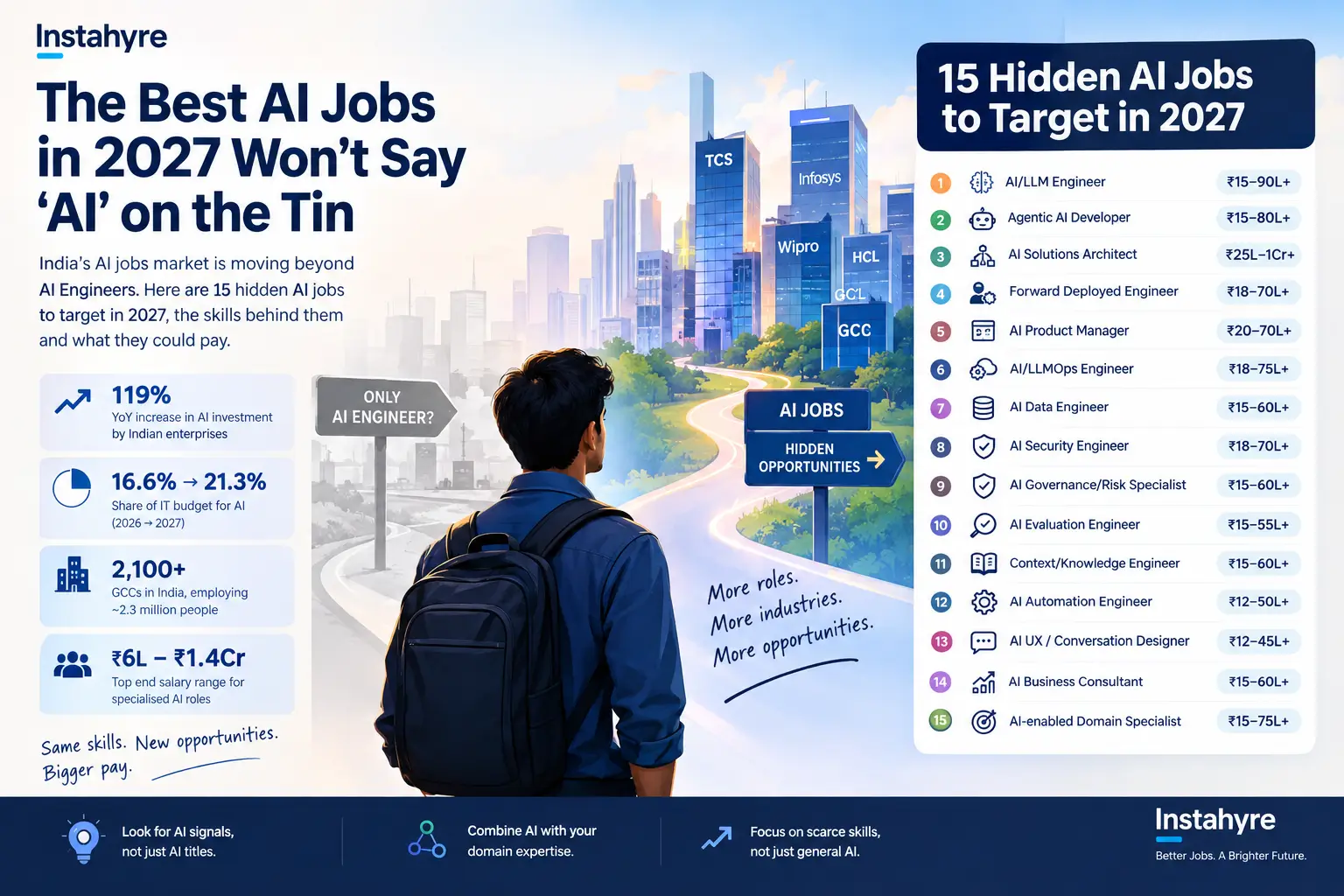
India’s AI jobs market is moving beyond AI Engineers. Here are 15 high-paying AI jobs to watch in 2027, the skills behind them and what they could pay.
If your 2027 job search starts and ends with the words **“AI Engineer,” you may be looking in the wrong place.
India’s AI jobs market is changing fast. The first wave was dominated by Data Scientists, Machine Learning Engineers and people building models. The next wave is broader: AI agents, enterprise integration, AI infrastructure, governance, evaluation, workflow redesign and domain-specific AI.
That means some of the most lucrative AI jobs in 2027 may not have “AI” in their job titles at all.
A Software Engineer building agentic applications is doing an AI job.
A Data Engineer building the data layer for enterprise LLMs is doing an AI job.
A Product Manager responsible for an AI-powered product is doing an AI job.
A Cybersecurity Engineer protecting AI systems is doing an AI job.
And a Forward Deployed Engineer embedding AI into a customer’s business could be one of the most strategically important AI jobs of all.
The money is moving accordingly.
Instahyre’s 2026 hiring data puts AI/ML Engineer compensation at roughly ₹6–14 LPA for freshers, ₹25–50 LPA for 3–5 years of experience and ₹2 crore+ at Staff/Principal levels. More specialised GenAI and LLM roles command significant premiums: a 3–5-year GenAI/LLM Engineer can benchmark around ₹32–55 LPA, while senior LLM engineers at leading GCCs can reach ₹85 lakh–₹1.4 crore.
The important bit is not simply that AI jobs pay more.
It is which AI jobs are beginning to pay more.
India’s AI spending is about to make the job market harder to recognise
The economics of AI Jobs are already shifting.
Indian enterprises increased AI investment by 119% year over year, ahead of the global 110% growth rate, according to ServiceNow’s 2026 Enterprise AI Maturity Index. AI currently accounts for 16.6% of the average IT budget of Indian companies, and that share is projected to rise to 21.3% by 2027.
That is a significant change.
When AI represented an experiment, companies needed small teams of specialists.
When AI becomes 21% of an IT budget, companies need an entire ecosystem around it.
They need people who can:
- build AI applications
- connect models to enterprise systems
- manage AI infrastructure
- create and maintain data pipelines
- evaluate model outputs
- secure AI systems
- govern AI deployment
- redesign workflows
- integrate AI into products
- train teams to use AI effectively
In other words, AI jobs multiply when AI moves from the lab into the business.
And India is already making that transition.
Microsoft India & South Asia president Puneet Chandok recently described India as having moved from AI pilots into the production phase. He also highlighted emerging roles including Forward Deployed Engineers and Enterprise Ontology Specialists.
That is the real 2027 signal.
The AI jobs market is becoming an AI-enabled jobs market.
The 15 hidden AI jobs to target in 2027
Here is where things get interesting about AI Jobs.
These are not necessarily 15 brand-new occupations. Some are existing jobs whose AI component is becoming increasingly valuable.
The salary ranges below are indicative benchmarks based primarily on current Indian compensation data and observed AI jobs. Actual compensation will vary significantly by company, city, experience, skills and equity.
| AI job to target | Indicative 2027 range | What makes it valuable |
|---|---|---|
| AI/LLM Engineer | ₹15–90L+ | Builds production GenAI systems |
| Agentic AI Developer | ₹15–80L+ | Builds autonomous AI workflows |
| AI Solutions Architect | ₹25L–1Cr+ | Connects AI to enterprise systems |
| Forward Deployed Engineer | ₹18–70L+ | Takes AI from demo to deployment |
| AI Product Manager | ₹20–70L+ | Turns AI capability into products |
| AI/LLMOps Engineer | ₹18–75L+ | Makes AI reliable in production |
| AI Data Engineer | ₹15–60L+ | Builds AI-ready data infrastructure |
| AI Security Engineer | ₹18–70L+ | Secures models, agents and AI data |
| AI Governance/Risk Specialist | ₹15–60L+ | Manages AI risk and compliance |
| AI Evaluation Engineer | ₹15–55L+ | Tests whether AI actually works |
| Context/Knowledge Engineer | ₹15–60L+ | Gives AI reliable enterprise context |
| AI Automation Engineer | ₹12–50L+ | Rebuilds workflows around AI |
| AI UX/Conversation Designer | ₹12–45L+ | Designs human-AI interactions |
| AI Business Consultant | ₹15–60L+ | Finds where businesses should use AI |
| AI-enabled Domain Specialist | ₹15–75L+ | Combines industry expertise with AI |
The ranges are deliberately broad.
That’s because the Indian AI jobs market has developed an unusually large premium for scarce skills. At the upper end, compensation is no longer behaving like a conventional IT salary ladder.
For example, Instahyre’s 2026 data shows Foundation Model Engineers at approximately ₹55 lakh–₹1 crore at mid-level, while Staff-level foundation-model roles can go considerably higher. LLM application engineering carries an estimated 30–50% premium over generalist ML, while MLOps/LLMOps carries a 25–45% premium.
The lesson:
Don’t just chase AI jobs. Chase scarcity within AI.
1. Agentic AI Developer
If GenAI was the headline of 2024–26, agents could be the headline of 2027.
Agentic AI developers build systems that can reason through tasks, use tools, access information and execute multi-step workflows.
This is very different from simply building a chatbot.
Current hiring data already shows the shift. A Quess analysis reported by India Today found agentic application development accounting for 22% of demand in the agentic AI category, followed by multi-agent orchestration and tool calling at 18%, RAG and context engineering at 15%, and architecture/system integration at 12%.
What to learn
Python, APIs, LLMs, RAG, tool calling, agent frameworks, evaluation and workflow orchestration.
Indicative 2027 pay
₹15–80 LPA+
At senior levels, especially in product companies, GCCs and AI-native firms, the ceiling could be substantially higher for such AI jobs.
2. Forward Deployed Engineer
This could become one of India’s most interesting AI jobs.
The Forward Deployed Engineer sits between engineering and the customer.
They understand the customer’s business problem, figure out where AI can solve it, build or configure the solution, integrate it into existing systems and help get it into production.
TCS is planning a Forward Deployed Engineering team of as many as 8,900 people, a striking indication of how large this category could become.
MathCo is also planning more than 2,000 specialised AI roles over four years, including Forward Deployed Engineers, as it shifts towards an AI-native model.
What to learn
Software engineering + cloud + APIs + LLMs + enterprise workflows + communication.
Indicative 2027 pay
₹18–70 LPA+
The biggest advantage: you don’t need to be a frontier-model researcher to join AI jobs.
3. AI Solutions Architect
Someone has to answer the question:
“How do we actually put all this AI into our technology stack?”
That’s the Solutions Architect.
AI Solutions Architects decide which models, platforms, databases, APIs, security layers and infrastructure should work together.
This is particularly valuable in India’s enormous enterprise and GCC market.
What to learn
Cloud architecture, LLM APIs, vector databases, RAG, security, data architecture, integration and enterprise systems.
Indicative 2027 pay
₹25 lakh–₹1 crore+
The higher end AI jobs will increasingly belong to architects who can handle both technical architecture and business outcomes.
4. AI/LLMOps Engineer
Getting an AI prototype to work is one thing.
Keeping it working at scale is another.
LLMOps engineers manage deployment, monitoring, latency, costs, model versions, evaluations and reliability.
Instahyre’s 2026 data puts MLOps/LLMOps at a 25–45% premium over generalist ML engineering.
That premium exists because enterprises are discovering a painful truth:
A brilliant AI demo is worthless if it cannot survive production.
Indicative 2027 pay
₹18–75 LPA+
5. AI Product Manager
The AI Product Manager could become one of the most valuable non-engineering AI jobs.
These professionals need to understand customers, products and AI simultaneously.
They decide:
- Where should AI actually be used?
- What should remain human?
- How should AI output be evaluated?
- How much inference cost is acceptable?
- What happens when the model is wrong?
- What does a good AI user experience look like?
This is not a “prompt engineering” job.
It is product management with AI depth.
Indicative 2027 pay
₹20–70 LPA+
6. AI Data Engineer
Data engineering is quietly becoming a huge factor in AI jobs.
Enterprise AI systems need clean, structured, searchable and governed data.
They need pipelines.
They need knowledge bases.
They need context.
They need data that can actually be retrieved when an AI system needs it.
The person building this infrastructure may still have Data Engineer on their LinkedIn profile.
But increasingly, they’re building the foundation underneath AI jobs across the company.
Indicative 2027 pay
₹15–60 LPA+
7. AI Security Engineer
Every new AI capability creates another security problem.
Prompt injection.
Data leakage.
Model abuse.
Agent permissions.
Sensitive information exposure.
Malicious tool calls.
AI-generated vulnerabilities.
AI Security Engineers will increasingly sit between conventional cybersecurity and AI engineering.
And this is another example of the AI + existing expertise combination becoming more valuable than AI expertise alone.
Indicative 2027 pay
₹18–70 LPA+
8. AI Governance & Risk Specialist
This may be one of the least glamorous AI jobs on LinkedIn.
It may also be one of the hardest AI jobs to automate.
Companies need people who can establish policies for AI use, assess risk, monitor models, document systems and ensure compliance.
The opportunity is particularly large in banking, insurance, healthcare and other regulated industries.
And the market has a substantial gap to fill.
ServiceNow’s research found that only 22% of Indian enterprises had implemented governance mechanisms such as AI testing, auditing and risk assessment.
Indicative 2027 pay
₹15–60 LPA+
9. AI Evaluation Engineer
Here is a job most people weren’t searching for two years ago:
AI Evaluation Engineer.
Their job is to determine whether an AI system is actually good.
Does it hallucinate?
Is it biased?
Does it follow instructions?
Does it perform better than the previous model?
Does an agent complete a task correctly?
Can it be trusted in production?
As AI moves into high-stakes enterprise workflows, evaluation becomes infrastructure.
Indicative 2027 pay
₹15–55 LPA+
10. Context / Knowledge Engineer
Large language models know a lot.
They don’t automatically know your company’s stuff.
That’s where context engineering comes in.
The job involves structuring enterprise knowledge, retrieval systems, taxonomies, ontologies and context pipelines so AI systems can access the right information at the right time.
Microsoft’s India leadership has already pointed to Enterprise Ontology Specialists as an emerging role.
That is a major clue.
Some of the most interesting AI jobs may be built around a simple question:
How do we make enterprise knowledge usable by machines?
Indicative 2027 pay
₹15–60 LPA+
11. AI Automation Engineer
Every company has workflows that involve:
open spreadsheet → copy data → check information → send email → update system → wait → repeat.
AI is increasingly capable of rebuilding these workflows.
AI Automation Engineers identify those processes and redesign them around AI, APIs, agents and automation platforms.
They don’t necessarily train models.
They make businesses run differently.
Indicative 2027 pay
₹12–50 LPA+
12. AI UX / Conversation Designer
The interface between humans and AI is still being invented.
How should users communicate with an agent?
How much control should they have?
How should AI uncertainty be communicated?
When should the system ask a question?
When should it take action?
That makes AI UX increasingly important.
The role may be called UX Designer, Conversation Designer or Product Designer rather than an AI job.
But if the person is designing human-AI interaction, it is absolutely an AI job.
Indicative 2027 pay
₹12–45 LPA+
13. AI Business Consultant
India’s IT services industry has a particularly large opportunity here.
Enterprises don’t necessarily need another person explaining what ChatGPT is.
They need someone who can answer:
Where can AI save us ₹50 crore?
Which workflow should we automate first?
What should we build versus buy?
How should we measure ROI?
That requires business understanding, technology awareness and AI fluency.
It is one reason consulting and services companies could become major creators of AI jobs.
Indicative 2027 pay
₹15–60 LPA+
14. AI-enabled Domain Specialist
This may be the sleeper category.
A financial-services professional who understands AI.
A healthcare professional who understands AI.
A supply-chain expert who understands AI.
A recruiter who understands AI.
A lawyer who understands AI.
These people can be more valuable than generic AI practitioners because they understand the actual business problem.
India’s AI market is becoming increasingly verticalised. Apollo Hospitals and Axis Bank, for example, are among the organisations using AI in important business functions.
The future may therefore belong to T-shaped professionals:
deep expertise in one domain + broad AI capability.
Indicative 2027 pay
₹15–75 LPA+
At senior leadership levels, the ceiling can be considerably higher.
15. AI/LLM Engineer
Yes, the obvious AI job still makes the list.
But even here, the job is changing.
The premium is moving away from “knows machine learning” towards specialised capabilities:
- LLM application engineering
- RAG
- AI agents
- model evaluation
- LLMOps
- multimodal AI
- post-training
- foundation-model engineering
Instahyre’s 2026 benchmark puts mid-level AI Engineers around ₹28–50 LPA, GenAI/LLM Engineers around ₹32–55 LPA, and senior LLM engineers at GCCs around ₹85 lakh–₹1.4 crore.
The further you move towards scarce, production-critical AI skills, the higher the premium.
The biggest AI jobs may actually be hiding inside GCCs
India’s Global Capability Centres deserve special attention.
The country now has more than 2,100 GCCs employing roughly 2.3 million professionals, according to recent industry estimates.
These aren’t simply back offices anymore.
GCCs are increasingly becoming engineering, analytics, product and AI centres for global companies.
That creates an unusual opportunity for Indian professionals.
A job description may say:
Senior Software Engineer
But the actual work could involve:
- building an AI platform
- developing enterprise agents
- integrating LLMs
- creating AI-powered products
- managing AI infrastructure
The same applies to Product, Data, Security and Operations roles.
The AI job is hiding in the responsibilities.
Not the title.
What is happening to traditional AI jobs?
There is a catch.
Not every AI job will be lucrative.
In fact, the AI market is becoming more polarised.
Traditional, repetitive technology work is increasingly vulnerable to automation and AI-assisted productivity. India’s IT-services model is particularly exposed because its economics historically depended heavily on linking revenue to headcount. The Financial Times has reported on the disruption AI is creating across India’s IT industry, including job reductions and pressure to shift towards higher-value work.
That creates a simple career rule:
Don’t become the person AI makes cheaper. Become the person who makes AI more valuable.
A programmer who only writes routine code is exposed.
A programmer who can architect, validate and ship AI-enabled systems is more valuable.
A recruiter who only screens CVs is exposed.
A recruiter who can use AI to redesign sourcing and assessment while applying human judgement becomes more valuable.
A data analyst who only creates dashboards is increasingly exposed.
A data professional who can build AI-ready data systems becomes more valuable.
The skill isn’t simply “AI.”
It is AI leverage.
The 2027 AI salary premium will follow scarcity
The most important salary trend may therefore be specialisation.
Instahyre’s 2026 data shows a substantial premium for specialised AI capabilities:
Foundation-model training: +70–120% over generalist ML
Post-training/RLHF/DPO/SFT: +60–100%
LLM application engineering: +30–50%
MLOps/LLMOps: +25–45%
Computer vision/multimodal: +20–35%
Recommender systems: +15–25%
These are not guarantees, but they show where the market is already putting scarcity premiums.
That suggests a useful strategy for 2027:
Don’t ask:
“What AI skill should I learn?”
Ask:
“What AI skill is becoming expensive because too few people can do it well?”
That is a much better career question.
What should Indian professionals actually learn?
For most professionals, the answer is not “learn everything about AI.”
Instead, build a three-layer stack.
Layer 1: AI fluency
Understand:
LLMs.
Generative AI.
Agents.
RAG.
Prompting.
AI limitations.
Evaluation.
Responsible AI.
Layer 2: Technical or functional depth
Pick your existing advantage:
Software.
Data.
Product.
Finance.
Cybersecurity.
Marketing.
HR.
Healthcare.
Operations.
Layer 3: AI application
Learn how AI changes your specific function.
That combination is far more defensible than generic AI knowledge.
A software engineer + AI is valuable.
A software engineer + AI + distributed systems is rarer.
A product manager + AI is valuable.
A product manager + AI + fintech is rarer.
A cybersecurity professional + AI is valuable.
A cybersecurity professional + AI + banking is rarer.
The market will pay for the intersection.
The new AI job-search rule
There is one habit Indian professionals should develop before 2027:
Read job descriptions for AI signals, not AI titles.
Look for words such as:
LLM
GenAI
agents
RAG
AI automation
model evaluation
AI governance
AI integration
AI platform
AI infrastructure
AI-powered product
workflow orchestration
enterprise AI
AI transformation
If these appear repeatedly in the responsibilities, you’re probably looking at an AI job.
Even if the title says:
Software Engineer.
Product Manager.
Data Engineer.
Solutions Architect.
Business Analyst.
Cybersecurity Engineer.
That is why the 2027 AI jobs market will be tricky.
The AI jobs won’t necessarily disappear.
They will disappear into other jobs.
The bottom line
India’s AI opportunity is entering its second act.
The first act was about building models.
The second is about putting AI to work.
That changes the talent equation.
India doesn’t just need more AI Engineers. It needs engineers who can deploy AI, product managers who can build around AI, data professionals who can feed AI, security experts who can protect AI, consultants who can implement AI and domain experts who can tell AI where it actually creates value.
And the salary premium will increasingly follow the people who can connect those pieces.
By 2027, the most lucrative AI job in India may not be the one with **“AI” written in the title.
It may be the one where AI is quietly becoming the most important part of the job.
The smartest job search, therefore, isn’t “Find me an AI job.”
It is:
“Find me a job where AI is changing the value of the work.”
That’s where the money is likely to be.

Want to be a part of Exclusive, Invite - only Recruitment events?
Get notified when new stories and insights are released.
You always have the choice to unsubscribe.
